
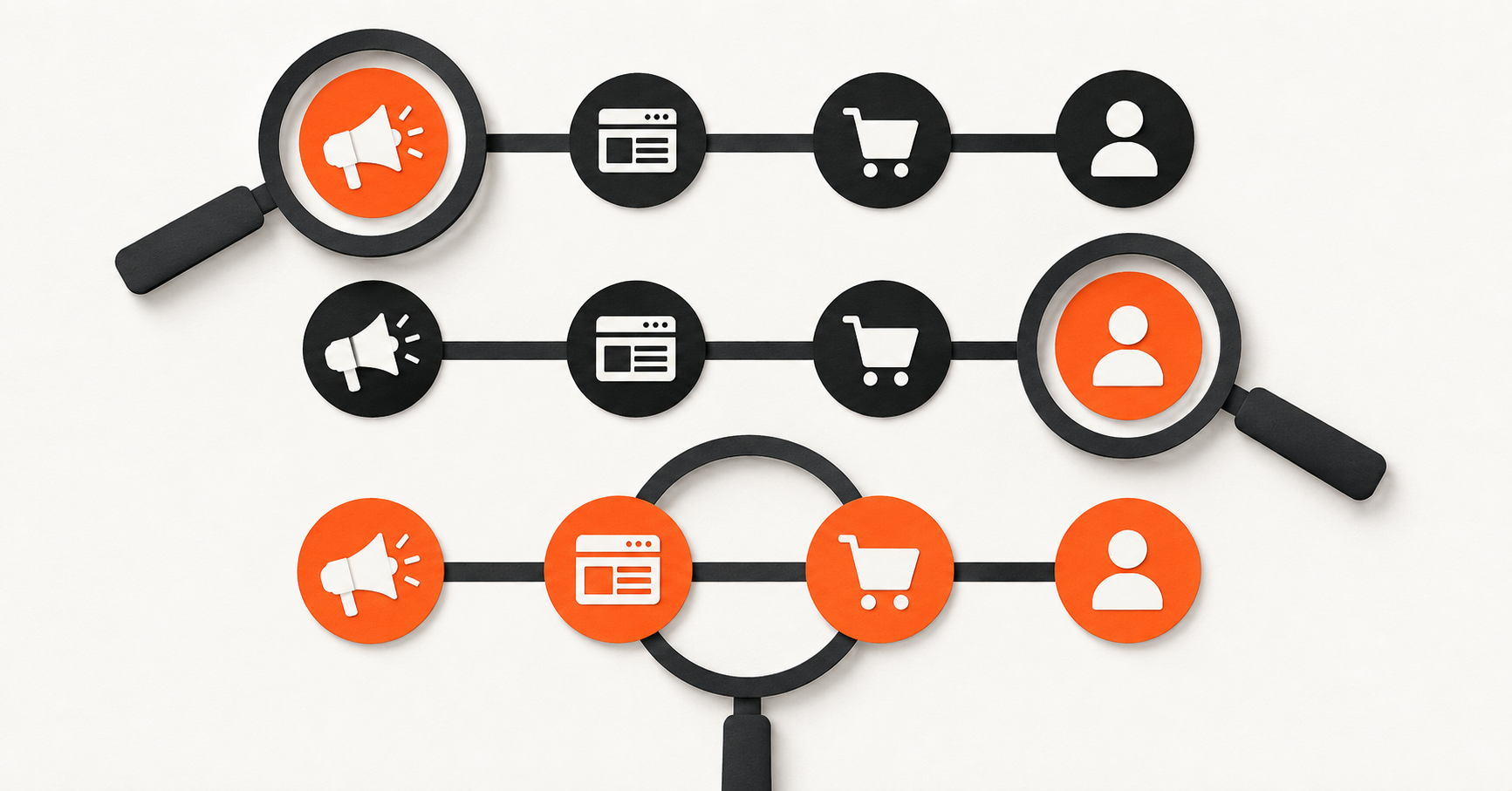
No attribution model is correct. Each one answers a different question about your pipeline, and the mistake most marketing and growth leaders make isn't picking the "wrong" model — it's picking a model more sophisticated than the data behind it can support.
If you're staring at a channel report trying to decide whether it's telling you the truth, the fastest way in is to know what question your current model is actually built to answer, and whether that's the question you need answered right now.
What Attribution Models Measure (and What They Deliberately Ignore)
Every attribution model does the same basic job: it takes the list of touchpoints between a prospect's first contact with your brand and a closed deal, and assigns credit for that deal across those touchpoints. The models differ only in how they split the credit.
That's it. An attribution model isn't measuring the quality of a touchpoint, and it isn't measuring whether a channel produced qualified pipeline versus noise — that's a separate tracking problem you have to solve before attribution is even worth running (our complete guide to B2B pipeline attribution covers where attribution sits relative to lead qualification and CRM setup). Attribution only tells you how credit for a deal you've already confirmed is real pipeline gets divided.
Four models cover most of what a company in the $500K–$2M ARR range will actually consider.
First-Touch Attribution
First-touch gives 100% of the credit for a closed deal to the first recorded touchpoint — the ad they clicked, the post they saw, the referral that brought them to your site.
What it tells you: which channels are good at starting relationships. If first-touch data says organic search and referrals dominate, that's a real signal about where net-new awareness comes from.
What it gets wrong: it credits nothing to whatever moved the deal from aware to ready-to-buy. A prospect who found you through an organic blog post eight months ago and converted after three sales calls and a demo gets recorded as a 100% organic win. That erases your sales team's effort, and everything that happened in between.
First-touch is honest about top-of-funnel discovery and dishonest about everything after it.
Last-Touch Attribution
Last-touch gives 100% of the credit to whichever touchpoint happened immediately before the deal closed or the form was submitted — often a demo request, a retargeting ad click, or a branded search.
What it tells you: which channel closes deals that are already in motion. It's useful when you're trying to figure out what pushes a warm prospect over the line.
What it gets wrong: it rewards the channel that happened to be there at the end and erases the channels that built the case for buying in the first place. Last-touch is the model most likely to overvalue paid search and retargeting — channels that intercept demand someone else already created — and undervalue content, referral, and organic channels that do the slower work of building trust.
If your reporting defaults to last-touch, which is what most CRMs and ad platforms do out of the box, you're almost certainly overcrediting your bottom-of-funnel channels and undervaluing the ones that did the earlier work.
Linear Attribution
Linear splits credit evenly across every touchpoint in the journey — first email open, ad click, webinar signup, demo request, sales call, all treated the same.
What it tells you: a rough sense of which channels show up most often, anywhere in the journey.
What it gets wrong: it treats a channel that showed up once, incidentally, the same as one that showed up at a decisive moment. Equal weighting is a real methodological choice, not a neutral default. It just happens to be the choice that requires the least data and the least judgment to implement, which is exactly why it's popular with teams that don't yet have the volume or tracking maturity for anything more granular.
Multi-Touch Attribution (Position-Based, Time-Decay, Algorithmic)
Multi-touch isn't one model — it's a family. Position-based (commonly U-shaped or W-shaped) weights the first touch, the last touch, and sometimes a middle milestone like an MQL or opportunity-created event, splitting the remainder across everything else. Time-decay weights recent touchpoints more heavily than old ones. Algorithmic (data-driven) attribution uses statistical modeling to assign credit based on which touchpoint combinations actually correlate with closed-won outcomes in your historical data.
What it tells you, when it's working: the closest available approximation of how the full journey contributed to a deal.
What it gets wrong — or rather, what it requires that most companies at this revenue band don't yet have: enough closed-won deal volume, consistent touchpoint tracking across every channel (UTMs, CRM activity logs, call tracking, all tied to the same contact record), and a sales cycle long and varied enough that the extra complexity buys you something first-touch or linear couldn't already tell you. Algorithmic models specifically need real statistical volume to find a pattern instead of noise — a company closing a handful of deals a month doesn't generate enough outcomes for an algorithm to learn a reliable pattern from.
The Real Question: Does Your Data Support the Model You Want to Use
This is the part most attribution content skips, usually because the people writing it are selling attribution software and have an interest in you believing more sophistication is always better.
It isn't. A multi-touch attribution model built on incomplete tracking data does not produce a more accurate view of a B2B pipeline than a simple last-touch or linear model — it produces a more confident-looking wrong answer. If half of a company's paid campaigns are missing UTM parameters, if sales activity like calls and demos never gets logged against the same CRM record as the marketing touchpoints, or if a contact's identity breaks apart across systems every time they switch devices, none of those gaps get fixed by switching to a more sophisticated attribution model. Algorithmic, data-driven attribution needs those gaps closed and needs enough closed-won deal volume to find a real statistical pattern; without both, it just launders the same missing data into a percentage that looks more precise than it actually is, and no dashboard labeled "attribution" will flag the difference on its own.
We've dealt with a smaller version of this ourselves. Two separate lead-capture points on our own site were recording attribution data under different, inconsistently-named session keys — a click ID picked up on one page was invisible to a form submitted on another. No attribution model, however sophisticated, survives that kind of gap. It isn't a modeling choice, it's a plumbing problem, and it's the kind of thing that's easy to miss until you go looking for it.
We don't have a universal deal-volume number that separates "ready for multi-touch" from "not ready" — that threshold depends on sales cycle length, deal complexity, and how many people typically touch a deal before it closes, and no single number is true for every company. What matters more than volume is whether you can answer these honestly:
- Is every paid, organic, and referral touchpoint tagged and tied to the same contact record, or are there channels you're currently tracking on trust rather than data?
- Does your CRM log sales activity (calls, meetings, demos) against the same record as marketing touchpoints, or do the two systems live in separate silos?
- Do you have enough closed-won deals in a given period that a percentage split across channels would represent a pattern, rather than the specifics of two or three deals?
If the answer to any of those is no, the model isn't your problem yet. The tracking is.
A Decision Framework for Companies in the $500K–$2M ARR Range
Most companies at this stage don't have full-funnel tracking maturity. That's not a failure — it's just where the data infrastructure is at this size. Here's how to match the model to what you actually have:
If your CRM and ad platforms aren't consistently tied to the same contact record yet: don't attribute at all until that's fixed. Any model built on gaps will mislead you more confidently than having no model.
If you have consistent tracking but low deal volume and a short sales cycle (one or two touches before close): last-touch is honest here, because there usually isn't much of a journey to distort. Overbuilding a multi-touch model on a two-touch sales cycle adds complexity without adding accuracy.
If you have consistent tracking, a longer sales cycle with several touchpoints, and moderate deal volume: linear or a simple position-based split gives you a reasonable read on which channels contribute, without requiring the statistical volume algorithmic models need.
If you have consistent tracking, high deal volume, and a multi-touch, multi-stakeholder sales cycle: this is where algorithmic multi-touch starts to earn its complexity — you finally have enough outcomes for a model to find a real pattern instead of fitting noise.
The direction of travel matters more than the destination: start with the simplest model your tracking can honestly support, fix the tracking gaps that model exposes, and move to something more granular only when the data underneath it justifies the extra complexity. Most companies in this range should be on last-touch or linear, not because sophistication is bad, but because their tracking hasn't earned multi-touch yet.
FAQ
Which attribution model is best for B2B companies?
There isn't a single best model — the right one depends on your sales cycle length, deal volume, and how consistently your touchpoints are tracked. Companies with short sales cycles and low deal volume are usually better served by last-touch or linear attribution; multi-touch models only produce reliable output once tracking is consistent and deal volume is high enough for a pattern to be statistically real.
Can I use more than one attribution model at the same time?
Running more than one attribution model at once is common. Many teams run last-touch for quick channel-performance checks alongside a linear or position-based view for budget conversations, since the two models answer different questions. What matters is knowing which model is behind any given number before you act on it.
Do I need dedicated attribution software to do this?
Dedicated attribution software isn't required to start. First-touch, last-touch, and linear attribution can all be built from CRM data and consistent UTM tagging without a dedicated platform. Attribution software becomes worth paying for once you're trying to run algorithmic multi-touch models, which need more data processing than a spreadsheet or a standard CRM report can handle.
Next Step: See How a Model Applies to Your Own Pipeline
Picking a model on paper is the easy part. Applying it means your CRM has to actually capture the touchpoints the model is supposed to weigh, which is a tracking and setup problem, not a strategy problem. Our next piece in this series, From Click to Closed-Won: Tracking a Lead Through Your CRM, walks through what that setup looks like in practice.
If you'd rather skip the DIY version, our free pipeline audit will tell you which channels in your current stack are actually producing pipeline versus which ones just look good in a last-touch report.
**